
The National Stock Exchange (NSE) on Tuesday said it has halved the lot size for trading derivatives contracts for the Nifty 50 index to 25 and also reduced the lot sizes of the Nifty Financial Services and Nifty Midcap indices as part of its periodic revision. "All contracts, i.e. weekly, monthly, quarterly, and half-yearly expires available for trading from the trade date of April 26, 2024, onwards will be with the revised market lot size," the NSE said, referring to applicability of the change for Nifty 50. The lot size in the derivatives segment refers to the fixed number of shares in a unit or group for which contracts are traded.

Stock exchanges are expanding the buffet of index derivatives even as the number of stocks permitted to trade in this space, generating an average daily turnover of Rs 450 trillion, is shrinking. This week, the National Stock Exchange (NSE) started issuing futures and options (F&O) contracts based on the Nifty Next 50 Index, bringing the total count of index derivatives to five.

The market regulator's newly proposed selection criteria for the over Rs 400-trillion-a-day futures and options (F&O) market could pave the way for the entry of popular stocks such as Life Insurance Corporation (LIC) of India, Jio Financial Services, Zomato, Paytm, DMart, and Adani Energy into the derivatives segment. The Indian derivatives market, which accounts for most of the trading volumes, could see big churn with over two dozen exits from the current list of 182 stocks due to an upward revision in the eligibility thresholds.

The sharp pullback in mid and smallcap stocks signals a cooling-off period in segments that previously attracted considerable investor interest.

Shares of Reliance Industries as well as Bharti Airtel began the trade on a positive note on Wednesday after the two firms announced their partnerships with Elon Musk's SpaceX for providing high-speed internet services in India. Bharti Airtel stock opened with a gain of 5.49 pc to hit a high of Rs 1,388.25 apiece on the National Stock Exchange (NSE). Soon, it pared all gains and traded 0.77 per cent lower to Rs 1,650.10 per piece.


Retail investors now own a larger share of smallcap companies than they did a year ago, thanks to their conviction in mutual fund (MF) schemes focused on this segment. Data from Capitaline shows that MFs' average holding in the National Stock Exchange Nifty Smallcap 250 Index stood at 9 per cent at the end of the October-December quarter of 2023-24 (FY24), up from 7.76 per cent in the same quarter of 2022-23.

The advance/decline ratio (ADR) - a gauge of market breadth - has remained negative (below 1) for a second consecutive month. In other words, the number of stocks declining is outpacing those rising, as a brutal selloff by overseas investors and lofty valuations weigh on sentiment. According to BSE data, the ADR for October stands at 0.98 for the second month in a row.

'The investigation is at a very critical stage. We are not going to give every single document.'

The index could be vulnerable to a bigger fall given the present market dynamics.

Five firms, including ACC Ltd, HDFC Asset Management Company and FSN E-Commerce Ventures that runs Nykaa, will be dropped from Nifty Next 50 index from September 29. NSE Indices Ltd, an arm of the National Stock Exchange, on Thursday said that Indus Towers and Page Industries will also be dropped from the index. Punjab National Bank, Trent, Sriram Finance, TVS Motor Company, and Zydus Lifesciences will be included in the Nifty Next 50 index, NSE Indices said in a statement.

The National Stock Exchange (NSE) has deferred its plan to change the expiry day of all index and stock derivatives to Monday from Thursday until further notice following markets regulator Sebi's consultation paper. The shift, which was scheduled to take effect on April 4, 2025, would have seen all index and stock derivative contracts move from Thursday to Monday.


The US market has been a standout performer this year, with the benchmark Standard and Poor's 500 (or simply the S&P 500) gaining over 16 per cent during the first half of calendar year 2023 (CY23) in what was its best first-half show since 2019. By comparison, India's National Stock Exchange Nifty 500 has gained 6.4 per cent. On the surface, it appears that the US markets have done exceedingly well. However, a deeper analysis reveals the gains in the domestic market to be more well-spread.

The benchmark National Stock Exchange Nifty has rallied 4 per cent, or 750 points, from this month's low to end at 19,732 on week ending November 17. Technical analysts say the market could consolidate around the current levels as it is nearing the resistance zone. "The near-term uptrend status of the market remains intact, but there is a possibility of some more consolidation or minor weakness for the Nifty in the next one to two sessions.

With new eligibility criteria for futures and options (F&O) coming into effect, Jio Financial Services and Zomato are strong contenders for inclusion in the derivatives segment, according to an analysis by Nuvama Alternative & Quantitative Research. The report suggests that these new F&O inclusions could also propel these two companies into the benchmark National Stock Exchange Nifty 50 during the March rebalancing.

SEBI alleges Jane Street placed bets on the stock market falling and then acted in a way to make the market actually fall so it could win its bet.
The domestic benchmark indices - the S&P BSE Sensex and the National Stock Exchange Nifty50 - had lost close to 1.5 per cent in three days recently before gaining slightly. Notwithstanding weakness and volatility, the Nifty50 has managed to hold on to the 18,000 mark, while the Sensex has managed to stay above the 61,000 level. The performance of the stocks that comprise these front-line indices remains polarised.

The Nifty Options would add to SGX's suite of Asian equity derivatives, which include SGX S&P CNX Nifty futures, the dominant Indian product for international participants.

Shares of Avenue Supermarts (DMart) have rallied 15 per cent in the past month, even as the benchmark National Stock Exchange Nifty has remained flat. The stock has garnered favourable commentary from both fundamental and technical analysts after three years of poor performance. "DMart has reached its first 52-week high since October 2021, taking off from solid base formations.
The decline in these was mostly due to company or sector-specific issues, say experts.

Among the Sensex firms, Tech Mahindra, Tata Motors, Infosys, Wipro, Tata Steel, Tata Consultancy Services, Reliance Industries and Axis Bank were the major gainers. Bajaj Finance, IndusInd Bank and Power Grid were the laggards.
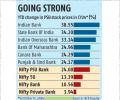
Stock Market News today, PSU banks: The year 2024 was a roller-coaster ride for Indian stock markets, marked by volatility driven by the Lok Sabha elections, Union Budget 2024, a slowdown in corporate earnings, and sticky inflation. Geopolitical tensions - particularly between Israel and Iran in West Asia - along with various stimulus announcements by China and yen carry trade rocked the equity markets throughout the year.

Among the Sensex firms, Bharat Electronics Ltd, Mahindra & Mahindra, Adani Ports, HCL Technologies, Eternal, Infosys, Bharti Airtel, Sun Pharmaceuticals, Larsen & Toubro, Hindustan Unilever and UltraTech Cement were the gainers. Bajaj Finance, Tata Motors Passenger Vehicles, Kotak Mahindra Bank, PowerGrid and Tata Steel were among the laggards.
The biggest gainer, Lupin, saw its market value appreciate nearly seven-fold.

The 30-share BSE Sensex surged by 477.24 points or 0.83 per cent to close at more than one-week high of 57,897.48. As many as 28 of its constituents closed with gains while two declined. The broad-based Nifty of the National Stock Exchange rose by 147.20 points or 0.86 per cent to settle 17,233.45, tracking gains in Sun Pharma, Asian Paints, and Reliance Industries.

'Sectors like e-commerce, small finance, housing finance, and healthcare are in great favour, and people are paying a PEG ratio of up to 5, which is dangerous.' 'Wealth destruction is inevitable.'

Mutual funds (MFs) reinforced their record monthly inflows in October with an investment of Rs 87,000 crore (up to October 29), softening the downside pressure on domestic markets. Their prior record for monthly inflows was Rs 48,139 crore in May. This unprecedented monthly buying partially countered record monthly sales by foreign portfolio investors (FPIs) of Rs 1.1 trillion last month.

Notwithstanding the ongoing decline in equity markets week after week, August has proven to be the most successful since December for initial public offerings (IPOs). In August of this year, six companies have collectively raised approximately Rs 4,269 crore through IPOs.

However, Tata Consultancy Services, Infosys, Tech Mahindra, UltraTech Cement, IndusInd Bank, Hindustan Unilever and ICICI Bank were the gainers.

'It is like a chicken-and-egg situation.' 'All these product tweaks are innovative, but traders won't move unless there is liquidity.' 'And liquidity cannot be generated until traders move.'

Among the Sensex firms, Larsen & Toubro, Axis Bank, Tata Steel, Bajaj Finance, Power Grid, Asian Paints, Mahindra & Mahindra and Bajaj Finserv were the biggest gainers. State Bank of India, Hindustan Unilever, Tata Motors and Titan were the laggards.

Small and midcaps are leading the charge in the latest market rebound. Since November 21, when the benchmark S&P BSE Sensex and the National Stock Exchange Nifty hit their recent lows and slipped into correction territory, the Nifty Smallcap 100 index has risen by 8 per cent, while the Nifty Midcap 100 has gained 5.7 per cent. Meanwhile, the Nifty 50 index has risen by 4.7 per cent during this period.
Index-based futures at the heart of the rivalry.
The upper market capitalisation (mcap) threshold for midcap and smallcap stocks in the mutual fund (MF) industry's revised list of stocks, to be announced this month, is set to see the second-highest yearly rise in the past five years. The list was first announced in 2018, and it has been revised every six months since then. According to estimates released by Nuvama Alternative & Quantitative Research, the upper threshold for the midcap and smallcap universes could come in at Rs 66,700 crore and Rs 21,900 crore in the next list.

The universe of stocks trading at a 12-month forward price-to-earnings (P/E) multiple of 50x or more has swelled by 2.5x to 104, indicating the growing froth in the market. In March 2023, the number of stocks with a P/E of 50x and 100x stood at 41 and 3, respectively, which has now grown to 104 and 9, according to an analysis by Kotak Institutional Equities (KIE).

NSE targeting hundreds of Japanese investors who poured money into India through yen-carry trades.
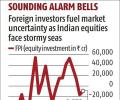
Foreign portfolio investors (FPIs) have withdrawn Rs 25,305 crore from domestic markets since September. FPIs were net sellers in the first two months of 2023, but from March to August, they purchased equities worth Rs 1.7 trillion. This selling trend has caused the National Stock Exchange Nifty Index to decline by 3.2 per cent from its September highs. FPI selling initially began in September as profit-taking but intensified due to rising US bond yields and uncertainty regarding the rate hike trajectory.

In dollar terms, the Nifty has gained 26.7 per cent in this year, while the Sensex has advanced 25 per cent during the same period.
 © 2026 Rediff.com - Advertise with us - Disclaimer - Privacy Policy - Sitemap - Feedback - About us - Terms of use - Grievances